
It’s nearly impossible for teacher Luke Hladek not to get emotional when he talks about a fifth-grade weather balloon project that took off 12 years ago from a private school where he worked in Wheeling, W.Va.
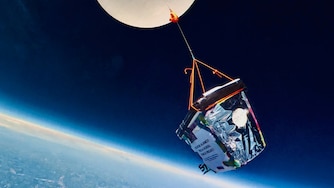
Each year, the balloon ascends to the stratosphere -- 7 miles from earth and 4 miles above the clouds -- and is retrieved by students eager to learn about lift, wind direction, velocity and other bits of science.
In September, the 12th balloon launched from the Children’s Museum of Pittsburgh on the North Side as one of “The 57” educational innovations touted by the Homestead-based Remake Learning network and supported by the Grable Foundation.
The reason Hladek and others become emotional is one young student who was so fascinated by the science project that it now bears his name. It has become the ultimate memorial to 10-year-old Josiah “JoJo” Titus-Glover, who died in November 2014 just as the first balloon was to launch.
Jojo’s Weather Balloon began as a one-off science experiment to launch a balloon with a payload stowed in a Styrofoam cooler to take measurements and aerial photos of Wheeling Country Day School’s 6-acre campus.
The project was inspired by a story of college students launching a weather balloon, and Hladek wondered if it would work with fifth graders.
Initially, the goal was simply to take aerial photos of the school’s campus. More than a science lesson, it was to be a love letter to the town and school, which educates pre-schoolers through eighth graders.
“The project was a lot about getting visuals and connecting with the wider community,” Hladek said.
JoJo’s balloon
JoJo was the type of student who read a book while walking to the gym, his fifth-grade teacher said.
“You have kids who are super into it, and then there are kids who come every day. Josiah was a tinkerer.... He pushed for different questions and answers. He was doing experiments at his house,” Hladek said.
JoJo’s unexpected death stunned the entire school, and some wondered if the launch should continue as planned. Then Jojo’s parents told the school’s principal, Liz Hofreuter, that their son had loved the balloon project so much that they wanted it to continue.
After JoJo’s funeral, his fellow students added a special touch: They filled the neck of the nearly 10-foot wide balloon with small handwritten notes expressing their love and saying goodbye to their friend.
“We let 10-year-olds launch a hypothesis that there was a curvature (of the Earth) and they could prove it,” said Hofreuter, whose daughter was JoJo’s classmate and friend.
Hladek could have taught his students that concept from a texbook, she noted.
“We were positioned in a way that created a culture of curiosity and collaboration. When a student died, his classmates leaned in to share grief and express love for their classmate,” Hofreuter said.
To the stratosphere!
The unusual project for fifth graders was possible because the country school is open to hands-on science experiments, even if the outcomes are uncertain, Hladek said.
Drones were cost-prohibitive then, and smart phones were just becoming popular. He thought about floating a party balloon with an iPad. The students were thrilled with the idea.
“I said, ‘Let’s do it. I’ll learn it with you,’” he said.
His students contacted local meteorologists and the National Weather Service. They consulted with ham radio operators and found a weather balloon manufacturer.
“As we researched it more, the sweet spot was to push the balloon to maximum altitude. It’s incredible that fifth graders were doing this research. We went down a lot of dead ends. We learned a lot about what wouldn’t work,” Hladek said.
“I wanted the kids to feel a collective spirit for science.”
Their excitement grew as the launch day neared. Finally, the balloon was filled and the students let it go.
“All of the research goes out the window,” Hladek said. “The balloon is going and catching the wind. Hopefully it’s not hitting a bird and will fly as high as it can.”
JoJo 1 ended up in Snow Shoe, Pa., and landed high up in a tree. Centre County residents helped the students retrieve the balloon and its payload.
The project achieved everything Hladek had hoped it would.
“You’re not writing a definition from a book. You have your hands on it,” he said.
His students calculated the correct amount of helium to lift the payload, which couldn’t exceed 4 pounds for unmanned balloons as per FAA regulations.
The determined sweet spot for lift was about 1,000 feet per minute, Hladek said, noting that each year, the students have been able to recover their launched balloon.
When it returns from the stratosphere, there is an unpleasant odor of fish and metal, he said. When he drives home with it, the balloon is so stinky he has to roll down his car windows.
Hladek, who is no longer a teacher at Wheeling Day School, continued to help out with subsequent balloon launches. He is now director of learning and innovation for the Pennsylvania Association of Independent Schools.
“Every time I thought it was ending, there came another opportunity.”
Pittsburgh joins in
Ryan Rydzewski, the Grable Foundation’s communications director, was impressed by the fifth graders’ creativity and the science behind the long-running science experiment.
“They learn about lift, wind direction and velocity, and then there are kids on the public relations and balloon recovery teams,” he said.
The launch in Pittsburgh Sept. 25 was “sending up a beacon of hope for the next 20 years,” Rydzewski said.
The project was a success because of the contagious excitement of the students and their teacher, he said.
“Luke Hladek didn’t have to do this. He chose to do this project because he thought it was exciting, which lit him up as an educator,” Rydzewski said.
“Rather than rote learning, we need a lot more hands-on, joyful projects.”


Comments
Welcome to Post-Gazette subscriber-only commenting community. Please review our community guidelines.