
Penguins Prospectus is an offseason project by Jason Mackey and Sam Werner that each weekday through Sept. 16 will examine 27 parts of the organization. Players and team personnel will appear according to when they played, coached or managed their first game with the Penguins, starting with Justin Schultz and ending with Marc-Andre Fleury.
Nick Bonino, center
Shoots: left
Height/weight: 6-foot-1, 196 pounds
Age: 28
Date of Penguins debut: Oct. 8, 2015 (the Penguins acquired from Bonino from the Canucks last offseason in exchange for Brandon Sutter)

2015-16 stats: Played in 63 regular season games with nine goals and 20 assists. Added four goals and 14 assists in 24 playoff games.
Contract situation: Entering final season of three-year deal with a cap hit of $1.9 million, will be an unrestricted free agent next summer.
HAT TRICK (THREE KEY NUMBERS)
3.66: Goals For Per 60 (GF60) for the HBK line of Carl Hagelin, Bonino and Phil Kessel during the Stanley Cup playoffs.
1.76: Increase in Kessel’s GF60 when he played with Bonino this season versus when he did not.
51.5: Bonino’s Corsi For Percentage (CF%), the highest of his career, also coinciding with the highest defensive zone start percentage (dZS%) of his career.
WHAT WE LEARNED
Three letters, H-B-K. While that trio may have been the story of the Stanley Cup playoffs, it’s worth remembering that it took a bit of time for the Penguins to find that combination. Bonino began the year anchoring the third line — his projected role after being acquired from Vancouver — and playing with, in various combinations, Chris Kunitz, Beau Bennett and Patric Hornqvist.
For whatever reason, the offense didn’t really click for Bonino early in the season. He had just three goals and seven assists through his first 40 games, and a hand injury in early January kept him out for six weeks.
Bonino returned in late February and, shortly thereafter, the HBK line was born. Hagelin, Bonino and Kessel all had skills that complemented one another, but they also possessed a unique chemistry that made them one of the Penguins’ most dangerous lines throughout the playoffs. Bonino scored six goals and added 13 assists in 23 regular season games after he returned from the injury and led the team with 14 assists during their playoff run.
2015-16 HIGHLIGHT
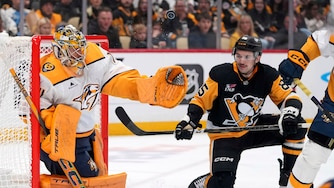
Scoring a game-winning goal in the third period of a Stanley Cup final game is the kind of stuff players dream about, and Bonino did that in Game 1. But, amazingly, that’s not the selection here.
Instead, let’s go with his overtime goal in Game 6 of the Eastern Conference semifinals against the Capitals. The Penguins had given up a two-goal lead and drew back-to-back-to-back delay-of-game penalties in a third period that wreaked havoc on fingernails across Western Pennsylvania. A loss would send the Penguins back to Washington for a do-or-die Game 7, not exactly an enticing proposition.
Instead, Bonino sent the Penguins in to the Eastern Conference final with his second goal of the playoffs at 6:32 of overtime. Fittingly, it came on assists from Hagelin and Kessel.
(Cue “BONINO BONINO BONINO!”)
Here’s the call to the goal that won the series for the @Penguins! #HockeyNightPunjabi pic.twitter.com/uwGjbUQ9Nu
— Hockey Night Punjabi (@HkyNightPunjabi) May 11, 2016
WHAT’S NEXT?
Line combinations can be fickle, so it’s no guarantee that the HBK line will be able to replicate its late-season and playoff success heading into next season. But it’s a pretty good bet — if Kessel is healthy — the line that ended the Capitals’ season three months ago when the Penguins welcome their rivals back to open things up Oct. 13. For as long as that line stays healthy and together, we can probably expect the best of Bonino, playing a solid centering role in between two wingers with supreme scoring ability (Kessel) and speed (Hagelin).
The question comes when, inevitably, things get shaken up, whether that’s due to injury, ineffectiveness or just a desire to try something new (it’s not out of the realm of possibility the Penguins want to give Kessel another shot at playing next to Sidney Crosby or Evgeni Malkin). Bonino wasn’t nearly as effective playing with less-talented wingers last year, so that would certainly be a step forward he could take in 2016-17.
As for beyond this year, it seems likely that Bonino’s future will be outside of Pittsburgh. If he can come anywhere close to his effectiveness of last year’s postseason, he’ll likely be due for a fairly significant raise, and that’s something the Penguins’ salary cap situation just can’t accommodate. For as much fun as HBK’s run last spring was, it doesn’t make sense for the Penguins (with great organizational depth down the middle) to shell out money for a third-line center like Bonino.
Sam Werner: swerner@post-gazette.com and Twitter @SWernerPG


Comments
Welcome to Post-Gazette subscriber-only commenting community. Please review our community guidelines.