
The Justice Department on Monday announced arrests and charges against hackers allegedly affiliated with a major ransomware organization and the recovery of more than $6 million extorted by the group named REvil.
The Treasury Department also announced the imposition of sanctions against the hackers, and the State Department added REvil to a bounty program offering monetary rewards for information leading to the identification or location of any its key leaders.
Taken together, the moves represent the most comprehensive coordinated action by the Biden administration to show its determination to counter ransomware attacks that have risen to such damaging levels that President Joe Biden has twice directly warned Russian President Vladimir Putin about the need to take action against such criminals operating from Russian soil.
Ransomware is a form of malware that locks up computers by encrypting the data on them, and hackers demand often exorbitant payments to unlock the computers. Those payments rose to more than $400 million globally last year, according to the White House. Once seen as a criminal nuisance, ransomware has been elevated to a national security threat after attacks in the spring on a major American fuel pipeline and on the world’s largest meat supplier.
The U.S. steps were taken as part of a wide-ranging criminal investigation with European authorities, which on Monday announced the arrests in Romania of two other alleged hackers linked to REvil. The Biden administration has launched what it calls a “whole-of-government” approach to marshal the resources of numerous agencies to confront the problem.
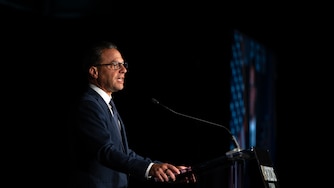
“Our message today is clear: The United States, together with our allies, will do everything in our power to identify the perpetrators of ransomware attacks, to bring them to justice and to recover the funds they have stolen from the American people,” Attorney General Merrick Garland said at a news conference Monday, standing next to the heads of the FBI and Treasury Department.
A major move was the arrest in Poland last month of a Ukrainian national who allegedly conducted a debilitating July 2 attack against a Florida-based software firm, according to officials. The individual, Yaroslav Vasinskyi, was indicted under seal on Aug. 11. He is accused of using ransomware against the firm Kaseya, affecting dozens of its clients when network management software updates were infected. Kaseya estimated between 800 and 1,500 businesses ultimately were affected, ranging from schools to grocery chains to hospitals. A second hacker, Russian national Yevgeniy Polyanin, remains at large, officials said.
Vasinskyi and Polyanin are charged in separate indictments with conspiracy to commit fraud and related activity in connection with computers, damage to protected computers and conspiracy to commit money laundering. The indictments were unsealed Monday in the Northern District of Texas.
“Vasinskyi’s arrest demonstrates how quickly we will act alongside our international partners to identify, locate and apprehend alleged cybercriminals, no matter where they are located,” Garland said.
Polish authorities arrested Vasinskyi on the border between Poland and Ukraine on Oct. 8, and the United States is seeking his extradition, Garland said.
Officials also announced the seizure of $6.1 million in ransomware payments extorted by Polyanin. He was linked to 3,000 ransomware attacks that netted $13 million in ransom from entities across the United States, including law enforcement agencies and municipalities throughout the state of Texas, according to the indictment.
“For the second time in five months, we announced the seizure of digital proceeds of ransomware deployed by a transnational criminal group,” Garland said. “This will not be the last time.”
In June, the Justice Department announced the recovery of $2.3 million in ransoms paid to a different Russian-speaking ransomware group called Darkside. That group was behind the May attack on Colonial Pipeline, which led the company to temporarily shut down its pipeline, causing widespread panic gasoline buying on the East Coast.
The latest seizure was the result of “good old-fashioned detective work,” Deputy Attorney General Lisa Monaco said. “We were able to recover ransom by following the money.”
REvil, which is also known as Sodinokibi, has attacked thousands of victims worldwide, Monaco said. REvil struck JBS, the world’s largest meat supplier, in the spring. That attack temporarily shut down some company operations in Australia, Canada and the United States. JBS paid an $11 million ransom to unlock its computers, according to the company.
Then in July, after the Kaseya hack, Biden warned Putin that the United States would take “any necessary action” to defend critical infrastructure.
Officials stressed that prompt action by victims to report their attacks to the FBI is key to identifying the culprits, recovering payments and countering the threat.
FBI Director Christopher Wray praised Kaseya for its “swift response.” The bureau, he said, then coordinated with other federal agencies and foreign law enforcement and intelligence services.
The Washington Post reported that the FBI, working with foreign partners, obtained early access to a decryption key that could help victims unlock their computers. It held on to the key for more than two weeks, with the assent of other agencies, in part because it was planning an operation to disrupt REvil and did not want to tip off the attackers.
“Ultimately, we were able to both unlock encrypted data and take bad actors out of operation,” Wray said on Monday. “A lot of times that can happen very, very quickly. Sometimes it takes a little bit longer.”
The State Department bounty program is offering up to $10 million for help identifying REvil leaders and up to $5 million for information leading to the arrest of anyone participating in an REvil attack.
Biden said in a statement that he made clear to Putin that “the United States would take action to hold cybercriminals accountable. That’s what we have done today.”
Polyanin is “a great test case,” said Dmitri Alperovitch, a founder of the Silverado Policy Accelerator think tank. “Will Moscow take action against him? If they don’t, that’s a sign that they’re not planning to cooperate.”



Comments
Welcome to Post-Gazette subscriber-only commenting community. Please review our community guidelines.