
David Aschkenas has captured the architectural beauty of Pittsburgh landmarks that echo with hockey sticks, stellar concerts and starry nights.
The Highland Park photographer documented the destruction of the silver-domed Civic Arena, construction of Consol Energy Center and that scientific bell jar, the Allegheny Observatory in Riverview Park. In Europe, he turned his lens on churches in Rome and synagogues in Prague and Poland. Last year, an exhibition of his Judaica images was shown at the American Jewish Museum in Squirrel Hill.
The Allegheny County Courthouse became his obsession in 2013 after Allegheny County Executive Rich Fitzgerald organized a committee to restore the building, which opened in 1888 and was designed by Henry Hobson Richardson.
“Snap Judgments,” a show of 24 of Mr. Aschkenas’ courthouse images, opened in November at Cohen & Grigsby, a Downtown law firm in the EQT Tower. The pictures are on display through the end of March and the public can view them for free by appointment.
Mr. Aschkenas had visited the national historic landmark only once before he spent 500 hours roaming its halls and climbing its staircases.
“When you work somewhere every day, everything becomes wallpaper. People who saw the show said, ‘I never saw that,’ when in reality, they walk by it every day,” he said.
Read More
Seeing the building bathed in red and green holiday lights or frosted in fresh snow, he was seduced by its arched windows, Samuel Yellin’s elaborate ironwork and decorative carvings done by 26 stone masons, 13 of whom were Italian. Sometimes shooting after hours, Mr. Aschkenas got to photograph judges’ chambers and other areas the public never sees.
The pencils on Judge Jeffrey A. Manning’s desk are shaped like gavels, leftovers from an election campaign. The hall tree in another judge’s chambers holds a black robe and the album cover of the Beatles’ “Sgt. Peppers Lonely Hearts Club Band.”
Mr. Aschkenas, who picked up a Nikkormat camera in 1973 after watching a print develop in a dark room, is still obsessed with taking pictures.
In his courthouse travels, he heard about the ups and downs of working in a landmark. One court employee said windows are so poorly insulated that it snows in the office. Others suggested replacing the windows and the sluggish elevators.
“Everybody I talked to had a different idea about what should be done with it.”
At the start of this year, Sheldon Goettel, a principal with the architectural firm Perfido Weiskopf Wagstaff + Goettel, began preparing a master plan for the courthouse. He will document how the building functions, the status of its major public spaces, undesirable changes that have been made and the county’s goals for improving energy efficiency. Also considered will be the National Park Service’s standards that apply to buildings on the National Register.
“Old rooms that were very large rooms were chopped up into smaller spaces,” Mr. Goettel said.
A good example is Room 300, formerly the third-floor law library. Now, it is a rabbit warren of cubicles for staff of the Allegheny County district attorney.
Later this year, Mr. Goettel said, “There will be big public meetings for people who use the building. By the end of the year, we will have a facilities plan,” he said, adding that it will be a road map for projects that must be done over many years.
“Mechanical systems in the building are inadequate,” Mr. Goettel said. “It’s too stuffy or too hot or too cold. None of us work well in badly conditioned space.”
The building’s steeply pitched terra cotta tile roof was patched 20 years ago, but rain and melting snow still leak regularly into the building. On the sixth floor, you can look up through the roof and see see so many pin-sized holes that it seems as if you are looking at stars, said Sam Kiss, a retired Allegheny County architect.
Grant Street was carved out of a steep hill. Between the 1830s and 1913, the street was lowered by 75 feet as that hill was gradually cut down. During the late 1920s, Grant Street was widened to 80 feet, forcing people to enter the courthouse through its cave of a basement.
“Getting people in and out of the courthouse is one of the challenges,” Mr. Goettel said.
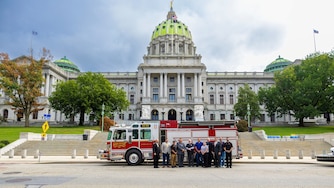
His firm oversaw restoration of the exterior of the state Capitol in Harrisburg plus that building’s roof, exterior walls and peristyle, the drum-shaped base that supports the Capitol’s dome.
Recently, the firm took apart and reassembled the west facade of Margaret Morrison College on the Carnegie Mellon University campus.
“That was an elaborate [Henry] Hornbostel building that hadn’t fared very well with 100 years of Pennsylvania winters,” Mr. Goettel said.
To see more photographs by David Aschkenas, visit www.daschkenasphoto.com, where prints and books about the courthouse are available for sale.
To see the exhibition ”Snap Judgments,“ call Cohen & Grigsby at 412-297-4900 and ask a receptionist to arrange a visit. The show is free and can be seen 9 a.m.-5 p.m. Monday through Friday at the law firm’s offices, 625 Liberty Ave., Downtown, in the EQT Tower.



Comments
Welcome to Post-Gazette subscriber-only commenting community. Please review our community guidelines.