
The line came together almost serendipitously.
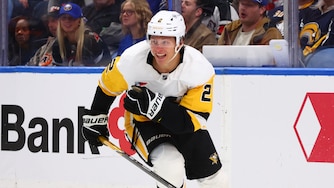
During a particularly injury plagued stretched in the 2019-20 season, coach Mike Sullivan threw together Zach Aston-Reese, Teddy Blueger and Brandon Tanev in part because they were three of the warm bodies available.
All three were at somewhat crossroads moments in their careers. Aston-Reese was a former goal-scoring machine in college who was trying to discover a niche at the NHL level. Tanev was a hair-on-fire addition working to find a fit with a new club. And Blueger was a late-blooming prospect finally ascending into a regular role in the middle of his own line.
It clicked.
Together, that trio formed a clear identity as a pesky tight-checking unit that could be counted upon for critical defensive zone starts and in matchups against top players.
This offseason, the line was tweaked — but not dramatically overhauled. Tanev left for Seattle in the expansion draft. Brock McGinn entered the fold as a free agent. Still, the continuity and the identity remained. You knew what you were getting every time the Blueger line went over the boards.
Read More
But on Tuesday, as the dust settles following NHL’s deadline day, Blueger finds himself a man without wingers.
The headline, obviously, is the addition of Rickard Rakell and the goal-scoring punch a two-time 30-goal scorer will provide to the top half of the lineup. At the same time, the subtraction of Aston-Reese provides an intriguing subplot in the bottom-six. With McGinn still recovering from an upper-body injury that’s expected to sideline him on a week-to-week basis, Blueger will find himself skating in the middle of two new wingers.
The question then becomes if the Penguins attempt to recreate a similar identity with new pieces — and how successfully they’ll do so — or if they Blueger line evolves.
“Just based on the group that we have right now, I think that the nature of Teddy's line is a little bit different,” Sullivan said. “But yet I still think Teddy being the cornerstone of his line, brings just brings a two-way skill set.
“He's very conscientious defensively. He's improved a lot in the faceoff circle this year for us. He defends extremely hard, but he also has an offensive dimension to his game and he has shown an ability to chip in with goal-scoring himself or helping with his line.”
Blueger’s value to the organization was underscored during his recent absence. In a best-case world, he’s packing more scoring punch as his offensive evolution continues while also bringing the same shut-down defensive attributes the team has grown to count on. Time will tell how it unfolds.
‘Gratitude’ from the coaching staff
Sullivan began his morning media session by thanking the two NHL roster players dealt in the Rakell trade, Aston-Reese and Dominik Simon.
“They were a pleasure to coach,” Sullivan said. “These guys were great teammates and did an awful lot for the Pittsburgh Penguins and our team. I just wanted to take a moment to express our gratitude on behalf of the coaching staff. We wish them all a lot of luck in their new endeavor in Anaheim.”
Zohorna recalled
One day after Radim Zohorna was, technically, re-assigned to the AHL affiliate in Wilkes-Barre/Scranton, he rejoined the organization’s NHL roster. Sullivan hinted this could be the case a day earlier. Players must be on an AHL roster at 3 p.m. on deadline day in order to participate in the Calder Cup playoffs.
Zohorna should be in the lineup on Tuesday against the Columbus Blue Jackets, as the Penguins have just 12 forwards currently on the NHL roster.
With two regular NHL players now gone (Aston-Reese and Simon) and two more injured (Jason Zucker and McGinn) opportunities could present themselves for young prospects on the cusp of the NHL like Zohorna, Drew O’Connor, Kasper Björkqvist and Valtteri Puustinen.
“They're part of our team for a reason,” Sullivan said. “They bring certain things to the table that that we think help us become the team that we're trying to become. For me, I think the biggest challenge for young players when they're trying to establish themselves in the NHL is just consistency of play, night-in and night-out. Shift-in and shift-out.”
Mike DeFabo: mdefabo@post-gazette.com and Twitter @MikeDeFabo.



Comments
Welcome to Post-Gazette subscriber-only commenting community. Please review our community guidelines.