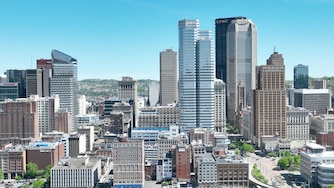
Pittsburgh and dozens of other cities nationwide have made their best pitches for Amazon’s second headquarters. Now, all have to wait until the online retailer vets the proposals. There is more reason now that at the beginning of the competition to believe that Pittsburgh has a big chance of making the short list of contenders.
Not only Pittsburghers are saying so. As the Post-Gazette’s Mark Belko reported Tuesday as part of his two-day package of stories on Amazon, Moody’s Analytics ranked Pittsburgh fifth on a list of 10 cities it considers having the the best shot of landing the online retailer’s HQ2. In that ranking, based on five criteria such as business environment and quality of life, Pittsburgh finished behind Austin, Texas; Atlanta; Philadelphia; and Rochester, N.Y.
But when Moody’s added a sixth factor, geography, Pittsburgh jumped to second on the list, behind Philadelphia. The geography category took into account such factors as position in the Northeast business corridor and proximity to Washington, D.C.
According to news reports, Gov. Tom Wolf’s administration offered more than $1 billion in tax incentives for Amazon to select Pittsburgh or Philadelphia for its HQ2, which will employ as many as 50,000 people and require as much as 8 million square feet of space. Pittsburgh has many choice locations to offer the Seattle-based company, and it may choose to spread its workforce space across various sites in its second headquarters city. Pittsburgh, unlike other cities, has lots of room for Amazon to grow.
Locations included in the proposal will be unavailable during Amazon’s vetting process, expected to last into next year. Hopefully, that does not impede other would-be buyers, but that’s a risk we’ll have to take.
Cities’ proposals were due to Amazon by midnight Thursday. Pittsburgh got its in a day early. That was the safe thing to do but it also shows that Pittsburghers will burn the midnight oil — remember how those steel mill furnaces used to light up the night sky? — to get a job done.

The reference to steelmaking shouldn’t elicit any groans. While the city has reinvented itself and relishes a high-tech image now, our industrial heritage is one of the intangibles that could set us apart and give us an edge in the Amazon competition. Pittsburgh’s work ethic, innovation and neighborliness span the old and new economies. They are as valuable to Amazon now as they were to the industries of yore. And while Amazon is best known as an online retailer, the “everything store,” its ambitions are boundless. It’s already a global leader in cloud computing services; Amazon Studios has become a force in the entertainment industry; it’s developing delivery drones that change the notion of transportation. These are all fields that match strengths in the new Pittsburgh — autonomous vehicles, software engineering, film and TV production.
Pittsburgh spent $300,000 to $400,000 on its proposal, much of it underwritten by the foundations whose generosity, across many generations, is another reason for Amazon to appreciate the city. The wooing continues, after a fashion. Pittsburghers may go on a new website, HQPittsburgh.com, and make their own pitches — in words, photos and videos — for Amazon’s investment.
As Mr. Belko reported, Amazon’s presence in Seattle, its home base, has generated explosive growth there. Amazon also has been blamed for skyrocketing housing prices and for making others in the city feel like second-class citizens. But it should be possible to leverage the pros and manage the cons, using Seattle’s experience as a guide.
Amazon and Pittsburgh fought to carve out niches in the digital economy, and both succeeded. Now, a partnership could open up many more possibilities. Pittsburgh has made its offer. It’s up to Amazon to grasp the city’s outstretched hand.



Comments
Welcome to Post-Gazette subscriber-only commenting community. Please review our community guidelines.