
It’s not an easy task for these students to get on a bus, but the drivers wait patiently as they find their way in using a cane. If they are lucky, there will be an empty seat not far from the door. What usually takes seconds, like pulling a cord to notify the bus driver to request a stop, isn’t so easy to do with a blindfold on.
That is what the students enrolled in Orientation and Mobility program at the University of Pittsburgh had to endure this summer. The students eventually learn to teach children and adults who are blind or visually impaired to improve their orientation and mobility skills. But first, the students have to experience what it’s like to be visually impaired.
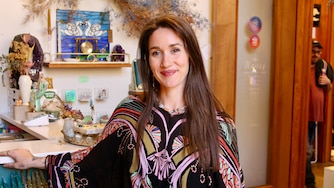
“It’s the type of content that you really can’t learn about by reading a textbook or listening to a lecture,” said their professor, Tessa McCarthy, who joined the Pitt faculty in August of last year.
The students, some of whom have visual impairments, spend seven weeks learning how to travel independently while using a cane and wearing a blindfold as part of a summer-session course. The other courses offered in the fall and spring are online.
“These seven weeks are difficult, sometimes scary,” Mrs. McCarthy said. “They learn so much, and I have never had a student who didn’t feel great about everything he or she accomplished during the classes.”
Mrs. McCarthy never thought she would become involved in visual studies. Her undergraduate degrees were in English and French. After graduating from college, she moved to France for a year, and when she came back she wasn’t sure what she wanted to do. Her first job was at the American Printing House for the Blind in Louisville, Ky., in the educational research department.
“I was working as a research assistant, and I thought it would be a good job for six months until I figured out what I really wanted to do,” she said. “As I got to know the people at [American Printing House], I fell in love with the work.”
After about a year, Mrs. McCarthy decided to get her master’s degree in orientation and mobility before getting a doctorate. Now she is teaching others to help visually impaired individuals.
There are 61,739 legally blind students in the United State, according to the American Printing House for the Blind.
Lindsey Palumbo-Gifford completed the Orientation and Mobility program this year. She first did the training at the Colorado-based Center for the Blind. Then she decided to deepen her knowledge in Pittsburgh.
“As a cane user and someone who has received services in the past, these foundational skills are critical for further skill development for those we will have the opportunity to work with in the future,” Ms. Palumbo-Gifford said. “Something people may not know or realize is that people with visual impairments can and do teach other people with blindness and visual impairments how to get around effectively and safely. People with blindness and visual impairment are people first.”
Jennifer Eaton, a teacher of the visually impaired in Lancaster, Pa., agrees.
“Individuals who are blind or vision impaired can enter numerous career fields, anything from medical, education, or trades like carpentry. In other words, the sky is the limit,” she said.
Ms. Eaton has been helping people with disabilities or delays to learn key skills for 16 years. But she wasn’t trained to teach her students orientation and mobility. That’s why she enrolled in the Pittsburgh-based program.
As an individual with low vision, Ms. Eaton said it turned out to be an interesting experience for her.
“What I found interesting was the reactions of the various drivers,” she recalled. “The only time I’ve been a cane user was while enrolled in the vision studies program. While under blindfold, I noticed that some of the drivers were extremely helpful. Giving me all kinds of verbal information. For example, how far away from the curb they stopped, or remembering to tell me when we were approaching my stop.”
She admits that when she used the bus after the class without the cane and asked for directions, some drivers were helpful while other drivers weren’t as much. Overall, Ms. Eaton says, she feels Pittsburgh is “extremely accessible” to individuals with vision impairments or blindness.
“I believe that orientation and mobility [training] should start for a child with a vision impairment as soon as they are able to move around within their environment and that begins early with scooting and crawling,” Ms. Eaton said.
Helping people learn to assist others who critically need assistance, Mrs. McCarthy said, is very satisfying.
“I feel so lucky every day to have such a dynamic and meaningful job,” she said. “I feel like what we do really helps people. I love what I do.”
Olena Goncharova is a staff writer for the Kyiv Post, Ukraine’s largest English-language newspaper, and was working this summer at the Post-Gazette as an Alfred Friendly Press Fellow.



Comments
Welcome to Post-Gazette subscriber-only commenting community. Please review our community guidelines.