
As a food editor, I love nothing more than trying new recipes that allow me to explore unfamiliar flavors or learn a new culinary technique.
Yet when it comes to eating out, sadly, I’m a creature of habit.
My husband and I tend to visit the same handful of restaurants on nights I don’t cook. And we almost always order the same favorite dishes.
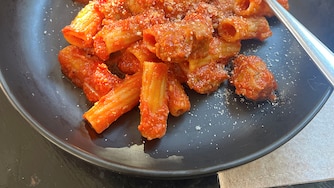
One go-to meal over the past few years is the mezzi rigatoni dish at The Red Hen, a critically acclaimed Italian-American restaurant in the Bloomingdale neighborhood of Washington, D.C.
For years, my husband’s job has been in Northern Virginia. As a result, I spend way too many hours driving the Pennsylvania Turnpike on weekends, boomeranging between Pittsburgh and his pied-à-terre in the Virginia countryside. When you’re always on the go, a familiar food in a familiar space is centering.
An ultimate expression of Italian-American comfort food – and who doesn’t crave a carb-filled burst of dopamine these days? − this sausage-studded pasta dish has been on its menu ever since chef/owner Michael Friedman first hung his namesake red hen sign over the door in April 2013.
Read More
The short, hollow tubes of homemade pasta are tossed in a rustic ragu beautifully seasoned with garlic, toasted fennel seeds, oregano and a generous snowfall of pecorino Romano. It’s as rib-sticking as it is soul-warming on a day when you need to recharge and reconnect.
Because Italian food relies on just a few simple quality ingredients, it can be easier than other cuisines for beginning home cooks to tackle and more experienced ones to perfect. Which got me thinking: Why not ask Friedman if he’d share the recipe for out-of-town culinarians?

Happily he did, along with one for a signature plant-based antipasta dish that’s also incredibly craveable.
Friedman, who graduated at the top of his class at the Culinary Institute of America, says he was looking to evoke the “Sunday gravy experience” of his youth when developing the pasta dish more than a dozen years ago.
While he was growing up in central New Jersey, his buddies’ grandmas always had a big pot of red sauce bubbling on the stovetop or braciola roasting in the oven when he visited on Sundays. It was a nice “juxtaposition” of tastes and ingredients for a kid being raised in a Jewish household.
His Bronx-born father was a huge fan of Italian food, too. That meant every family celebration took place in an Italian restaurant.
“It’s a comfort food for me,” Friedman says.
The hearty entree has been a runaway hit since day one. The chef credits the restaurant’s focus on quality and consistency.
“It tastes exactly the same today as it did eight years ago,” he says.
In fact, Friedman — whose All-Purpose Hospitality Group owns and operates five other (mostly Italian) restaurants— considers his mezzi rigatoni his most popular dish.
“If we took it off the menu, there would be a riot for real,” he says.
It certainly hit a digital frenzy in 2023 after former President Joe Biden and his wife, Jill, both ordered the dish on a date night, sparking a debate on social media about whether a couple should order the exact same bowl of pasta.
“It got me on the ‘Today’ show,” Friedman says with a laugh. “Sometimes you don’t want to share.”
Star power can’t help but elevate a dish. But I believe The Red Hen’s ragu owes some of its magic to the floral kiss of fennel pollen, a rare and expensive finishing spice known as “culinary fairy dust.”
“I just love it,” Friedman says.
The chef, who learned to love the spice while staging in professional kitchens in Los Angeles and New York, agrees it is the “secret addition” that takes the pasta to the next level.

A deep-gold granular powder, fennel pollen is hand collected from wild fennel’s tiny flowers during summer, then dried and sifted to remove any leftover twigs or coarse stems. It’s used as a rub or finishing spice for meat, fish, vegetables, pasta, salads, baked goods and anything else that calls out for a citrusy, sweet finish.
Used judiciously, it perfumes a dishes without overpowering it.
As for the broccolini appetizer Friedman also shared? It was born as a Venetian dish studded with plumped sultanas and toasted nuts in a vinegary base and served with fish. Now, it is an amalgamation of northern and southern Italian cuisine.
A hybrid veggie that holds up extremely well to char, broccolini is little sweeter than broccoli. At The Red Hen, it’s dressed for success in a vibrant Calabrian chili vinaigrette and topped with toasted hazelnuts for crunch.
It’s everything you want to start out a meal, Friedman says − smoky, crunchy, spicy, sweet and salty. It can be served warm, room temperature or cold.
He suggests keeping the vinaigrette in your fridge “as a secret weapon.”
I concur!
The Red Hen’s Mezzi Rigatoni
PG tested

This rib-sticking pasta has been on The Red Hen’s menu since it opened in 2013. The list of ingredients may look long, but if you pre-measure, it comes together very quickly.
Fennel pollen can be hard to find locally and is super expensive — a 0.48 ounce container costs $15 on Amazon — but it adds a beyond-salt-and-pepper dimension of seasoning.
I used regular size instead of mezzi (small) rigatoni and it was fine.
½ teaspoon fennel seeds
¼ cup plus 1 tablespoon extra-virgin olive oil, divided
2 cloves garlic, peeled and thinly sliced
One (24-ounce) jar tomato puree
2 teaspoons fennel pollen
½ teaspoon dried oregano
½ teaspoon fine salt, plus more as needed
¼ teaspoon freshly ground black pepper
1 pound mild Italian sausage, from links with casings removed, broken into 1-inch pieces
12 ounces dried mezzi rigatoni pasta
2¼ tablespoons unsalted butter
5 tablespoons finely grated pecorino Romano, plus more for serving
3 tablespoons finely grated Parmigiano-Reggiano
In a small skillet over low heat, toast fennel seeds until fragrant, 5-7 minutes, stirring occasionally. Transfer to a plate to cool, then finely grind in a mortar and pestle or a spice grinder.
Bring a large pot of water to a boil.
Meanwhile, in a cold large pot, combine ¼ cup of olive oil and garlic. Turn the heat to medium and cook, stirring occasionally, until the garlic is lightly toasted around the edges, 3-5 minutes. Slowly stir in tomato puree, followed by ground fennel, fennel pollen, dried oregano, ½ teaspoon of salt and black pepper.
Bring to a simmer, reduce the heat to medium-low and cook, stirring occasionally, until somewhat thickened and darker, adjusting the heat as needed to prevent scorching or splattering, 20-25 minutes. When you drag a spatula through the sauce, it should briefly hold a line where you can see the pan underneath.
While the sauce is simmering, line a large plate with towels and keep it nearby. In a large skillet over medium heat, heat the remaining 1 tablespoon olive oil until shimmering.
Add sausage and cook, stirring occasionally, until well-browned and cooked through, about 10 minutes. Transfer the sausage to the prepared plate to drain the fat.
Add sausage to tomato sauce and continue to simmer for an additional 10-15 minutes.
Once the water is boiling, salt it (for about 1 gallon of water, add 1½ teaspoons of fine salt). Add pasta and cook according to the package instructions for al dente.
Reserve ¼ cup of the pasta water, then drain.
Reduce the heat under the sauce to low, and stir in butter until it is incorporated and the mixture is glossy. Add pecorino Romano and Parmigiano-Reggiano, and stir to incorporate and create a smooth sauce. Add cooked pasta to tomato sauce.
Gradually add the pasta water, stirring until the sauce coats the pasta. If it seems a bit runny, continue to cook and stir over low heat until the sauce adheres to the rigatoni.
Transfer to a serving platter or bowl and serve warm, topped generously with more grated pecorino Romano.
Serves 4-6.
− Mike Friedman, The Red Hen
Grilled Broccolini ‘Calabrese’

PG tested
For Calabrian chili vinaigrette
A hybrid of broccoli and Chinese cabbage, broccolini lends itself to grilling because its long, slender stalks hold their structure over high heat. My grill is packed up for the winter so I did a quick stovetop char in a cast-iron skillet. The spicy-sweet Calabrian chili vinaigrette is addictive — you’ll want to use it on every kind of vegetable and also salads.
Jarred Calabrian chiles are available in most Italian grocery stores; if you can’t find them, another high-quality spicy pepper packed in oil will work as well.
I substituted toasted almonds in the broccolini recipe and was a little more sparing with the vinaigrette.
4 Calabrian chilies, stems and seeds removed
2 tablespoons Calabrian chili oil (from the jar)
4 jarred peppadew (sweet piquanté) peppers, stems and seeds removed
2 garlic cloves, minced
½ cup lemon juice
½ cup apple cider vinegar
½ cup maple syrup
1½ cups extra virgin olive oil
1 teaspoons dry oregano
1 teaspoon kosher salt
½ teaspoon black pepper, ground
For broccolini
2 pounds broccolini, washed
3 tablespoons extra virgin olive oil
1 teaspoon kosher salt
½ teaspoon black pepper, ground
To finish the dish
1 cup hazelnuts, toasted and roughly chopped
10-12 basil leaves, roughly torn
Prepare the Calabrian chili vinaigrette. Add all the ingredients to a blender cup. Blend on high until everything is well incorporated. Pour into a jar or multiple jars and refrigerate until ready to use. (The vinaigrette can be made up to one week ahead.)
Prepare broccolini. Heat your grill to medium high. Toss the broccolini with the olive oil, kosher salt and pepper.
Place the broccolini over the hottest part of the grill. Cook for 1 minute, then flip so the other side gets grilled as well. Cook for 1 more minute.
Move the broccolini to the cooler part of the grill and continue cooking for 2-3 minutes, until the stems are tender. (You can test by putting a knife into the stalk — if it is removed easily, it’s ready.)
Remove the broccolini and place in a bowl or casserole dish. Pour 1 cup of the vinaigrette over the vegetables and toss well.
Place the broccolini onto a platter and drizzle over the remaining vinaigrette left in the bowl.
Top with chopped toasted hazelnuts and torn basil leaves. Serve warm.
Serves 4-6.
− Mike Friedman, The Red Hen




Comments
Welcome to Post-Gazette subscriber-only commenting community. Please review our community guidelines.