
A “Secure Innovation Center” is slated for construction this fall to help Pittsburgh’s artificial intelligence sector compete for classified federal contracts, the AI Strike Team announced Wednesday.
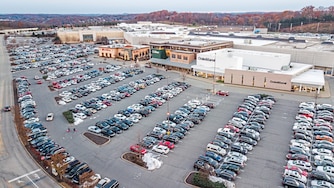
Expected to open early in 2026 in Bakery Square, the classified facility will be the first of its kind in the region, supporting a range of federal classification levels, including “secret.”
“This is an absolutely vital piece of infrastructure,” Andrew Moore, CEO of Lovelace AI, said in a statement Wednesday. “It creates the foundation for serious government collaboration — something Pittsburgh’s ecosystem is more than ready for.”
Lovelace AI, based in Bakery Square, is a startup that uses data analytics to address national security concerns and disaster response. Mr. Moore was the former dean of Carnegie Mellon University’s School of Computer Science, and is a national security adviser.
The project is expected to create more than 400 “high-wage” jobs, along with $25 million in annual payroll and millions in regional tax revenue, officials said.
Called a “Sensitive Compartmented Information Facility,” or SCIF, the 6,000-square-foot building will be located on “AI Avenue,” joining other AI companies and technology innovators there, including Google and Duolingo.
Read More
“We’ve already seen it: promising defense startups moving to regions with SCIF access,” said Joanna Doven, the executive director of the AI Strike Team. “Each time it happens, Pittsburgh loses not just innovation, but jobs, patents, tax base, and momentum.”
As data centers are increasingly peppered across the state, and artificial intelligence infrastructure sees investments such as Amazon’s $20 billion to develop artificial intelligence “innovation campuses” across the commonwealth, the Strike Team said this project provides “urgently needed secure workspace” for the region.
Ms. Doven has been coordinating with local industry leaders to build out interconnected infrastructure for an artificial intelligence economy. As the leader of the AI Strike Team — a group seeking to shape Pittsburgh into a global hub of AI innovation and generate 100,000 jobs in the region by 2028 — Ms. Doven was instrumental in securing the facility in partnership with Fort Pitt Secure, LLC.
“This is a mission-critical capability for any region serious about national security,” said Dennis Andersh, president and CEO of Parallax Advanced Research, the Ohio-based parent company of Fort Pitt.
Mr. Andersh said he anticipates collaborating with institutions including Carnegie Mellon University, the University of Pittsburgh and the Advanced Robotics for Manufacturing Institute, alongside “key ecosystems partners” such as the Pittsburgh Technology Council, the Allegheny Conference and the AI Strike Team to expand national security partnerships in the city.
“The center at Bakery Square is the first site, and we aim to build additional Centers as demand requires and local support enables,” he said.
Brian Kennedy, the senior vice president of operations and government affairs for the Pittsburgh Technology Council, said the trade group applauds “the vision behind bringing SCIF capabilities to our region.”
“This investment addresses one of the most significant barriers holding back our defense-tech sector,” Mr. Kennedy said. “With the growth of defense contracts and the addition of accessible SCIF infrastructure, Pittsburgh is poised to unlock billions more in federal investment — accelerating the expansion of our AI and robotics ecosystem.”
The Council leads Pittsburgh’s Defense Robotics and Innovation Coalition, which aims to connect the city’s AI talent and robotics capabilities to opportunities with the Department of Defense.
Defense contract activity in Pittsburgh and beyond has skyrocketed from $400 million to nearly $15 billion over the past five years, according to the Council.
Gecko Robotics, a start-up that lives next door to the Council on the North Shore, just reached unicorn status, or over $1 billion in value last week. Among its clients is the U.S. Navy.
The secure center comes at a time when venture capital for AI and defense tech sectors is surging and more than $150 billion of the Department of Defense’s 2025 budget is allocated toward defense technology.
“These aren’t just engineers and coders,” Ms. Doven said of the project. “SCIF-enabled growth creates demand for secure construction workers, fiber installers, mechanical engineers, and cleared professionals in advanced manufacturing. It’s a full-stack economic engine.”




Comments
Welcome to Post-Gazette subscriber-only commenting community. Please review our community guidelines.