
In the spring of 1968, I was a senior at George Washington University, living over a liquor store about six blocks from the White House. While the nation was still reeling from the assassination of Martin Luther King Jr. in April, Sen. Robert Kennedy was shot in Los Angeles on June 5.
Three days later, I was on Sen. Kennedy's funeral train from New York to Washington, taking more than 300 photographs.
Why me? I had worked on the GW student newspaper, first as a photographer, then as a writer. We had a relationship with the U.S. Student Press Association, a sort of Washington news bureau for student newspapers all over the country. The Kennedy press office called USSPA on June 7, said they wanted some student journalists on the funeral train, and asked if they knew some students who might be available on short notice. The folks at USSPA knew me because they had distributed some of my photos and articles. Dumb luck -- I happened to be home and answered the phone.
Seth Beckerman is a writer living in Mt. Lebanon (s.beckerman@vip.cgnet.com).
I stuffed a clean shirt in my camera bag with two Pentax 35mm cameras, and flew to New York the next morning. My press pass did not admit me to St. Patrick's Cathedral for the actual funeral, but it did allow me entrance to the press area outside the church and a place on the train.
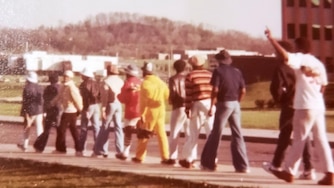
Once the train emerged from the tunnel under the Hudson River, I realized that it would be ridiculous to sit and look out the window. All the action -- which was actually a constantly changing tableau of reverence -- was clustered along the tracks for the 200 miles between New York and Washington.
I stood at the end of one car shooting through the top half of an open door to avoid the problems of photographing through a window. I could stick my head out of the car to see what was ahead, plus it allowed me much more maneuverability and I could switch sides fairly quickly. The photographers on one side of the car would alert those on the other side of the car if there was something interesting coming into view.
I moved from one side of the car to the other depending on the crowds, track layout, alerts from other photographers and specific vistas. What was then normally a four-hour trip took well over eight hours -- the train moved slowly to accommodate the masses of people, which often crowded dangerously close to the tracks.
I'm not sure anyone could have predicted the turnout along the route of the train -- later reported to be about 1 million people -- let alone the reverence that people exhibited. I was astounded not only by the size of the crowd, but also by the tender sentiments that were on display. Whole families were holding hands, individuals with tear-stained faces stood solemnly, groups of friends looked stunned. Some people climbed on whatever was nearby so they could get a better view, particularly in places where the crowds were large. One man who had climbed on top of a box car touched the electric line above the car and was electrocuted and fell to the ground. I have a photo of his smoking body lying next to the box car.
The press was confined to several cars at the front of the train, well away from the glitterati in the rear cars. At one point I decided to try to take some pictures in the first glitterati car. I managed a few, but was soon chased out. All the women in that car looked alike -- same little black dress, same perfect tan, same hairdo, same single strand of pearls.
It was a hot and humid evening when the train reached Washington's Union Station, and the crowds around the station were large and pushy. I was exhausted -- emotionally wrung out from the eight-hour wave of passionate sentiments along the tracks, but also physically exhausted from standing for so long and trying to keep my balance on the swaying train. As the procession headed to Arlington National Cemetery for the burial, I headed for the darkroom to develop my film.
The Next Page is different every week: John Allison, thenextpage@post-gazette.com, 412-263-1915
Later that year someone who was writing a biography of Sen. Kennedy expressed interest in using some of my photos in his book. But in July of the next year Sen. Ted Kennedy drove off a bridge in Chappaquiddick and the market for Kennedy books dried up.
A few of these pictures were printed in the GW alumni magazine. Otherwise they have not been previously published.
This story was originally published with images that are no longer available.
Comments
Welcome to Post-Gazette subscriber-only commenting community. Please review our community guidelines.