
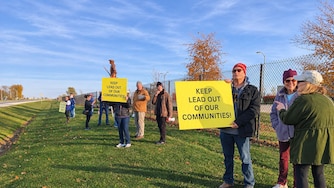
Environmental justice delayed is justice denied, said Veronica Coptis, a sentiment echoed by other speakers at Wednesday afternoon’s state Department of Environmental Protection public meeting in Waynesburg, Greene County, about how to change Pennsylvania’s decade-old “EJ” policies.
“For too long the DEP has not taken its responsibility to environmental justice seriously and prioritized it in the permitting process,” said Ms. Coptis, a Greene County resident and executive director of the Center for Coalfield justice. “The environmental justice policies currently in place are not effectively implemented, and sometimes are not implemented at all.”
James Rosenberg, with the organization Fayette Marcellus Watch, said the state’s failure to have shale-gas development permits trigger an environmental justice office review is a massive deficiency that makes “delivery of genuine EJ in Pennsylvania’s Marcellus Shale country … almost non-existent.”
The DEP “listening session,” attended by about 30 people, was the first of nine the department will hold around the state to hear ideas about how to make existing environmental justice policy more responsive to the needs of poor and minority communities.

The second “listening session” is scheduled for 4 to 6 p.m., Thursday, at the Blakey Center, 1908 Wylie Ave., in Pittsburgh’s Hill District.
“We’re here to invite feedback from the communities that are affected,” said Patrick McDonnell, DEP acting secretary, who is attending the meetings. “One of the things that’s important to me is to get the perspectives and hear about the experiences of people so we can inform our decision making.”

Pennsylvania established its Office of Environmental Equity in 2002, after it was sued in federal court for environmental racism, as it was considering approving a sixth waste disposal facility in Chester, a poor and minority community north of Philadelphia.
In 2015, the name of the operation was changed to the Office of Environmental Justice, and then-DEP Secretary John Quigley promised enhanced review, notification and outreach to the 851 “EJ communities” in the state, where at least 20 percent of the population lives below the poverty line or 30 percent or more are non-white.
Mr. Quigley said at the time that, going forward, shale-gas permits would trigger review by the office, but Mr. McDonnell said that has not happened. Prior to 2015, almost 500 shale-gas wells were granted permits in environmental justice communities without any involvement by the office.
Carl E. Jones Jr., a Philadelphia attorney, was hired to head the office in October 2015, which at that point hadn’t had a director or any staff for two months.
Mr. Jones now oversees a staff that consists of just two regional directors, and Ms. Coptis said she has little confidence that funding for the office will reach a level to make it effective.
“They talk about improving the EJ policies, but there’s no money in the state budget to do that,” she said. “So I have a lack of trust. I’m happy the DEP came to Greene County to listen to us, but I have big concerns about how any improved policies can be implemented.”
Kirk Jalbert,a researcher at Fractracker, said the DEP’s environmental justice program doesn’t adequately assess the cumulative risks faced by those living near oil and gas development operations that have a history of problems.
“There are more than 10,000 unconventional gas wells in the state and they’ve registered 6,600 violations since 2005. Twenty percent of those violations have occurred in three census tracts in Susquehanna, Lycoming and Bradford counties,” he said. “At what point don’t those census tracts deserve additional industrial burdens?”
The DEP will accept additional comments on its environmental justice policy update until May 27. A listing of the times, dates and locations of all the DEP environmental justice listening sessions, along with supporting documents and commenting instructions, can be found at: http://www.dep.pa.gov/PublicParticipation/OfficeofEnvironmentalJustice/Pages/Listening-Sessions.aspx
NOTE: This post has been updated from the original to correct the spelling of Mr. Jalbert’s first name.
Don Hopey: dhopey@post-gazette.com, 412-263-1983, or on Twitter @donhopey.



Comments
Welcome to Post-Gazette subscriber-only commenting community. Please review our community guidelines.