
Penguins winger David Perron isn’t entirely sold on the idea of three-on-three overtime.
That’s hardly a surprise.
After all, Perron is a big fan of four-on-four hockey, and he has had a lot of success in shootouts.
With the NHL adopting three-on-three overtime this season, four-on-four will disappear unless it happens naturally during the course of regulation, and shootouts likely will happen a lot less often.
Of course, that’s precisely what the NHL wants. It hopes to have about three-quarters of games that are tied after three periods settled before reaching a shootout.
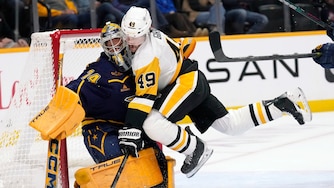
The Penguins will get their first exposure to three-on-three at the conclusion of their exhibition opener at 7:08 p.m. today in Columbus, Ohio. They and the Blue Jackets will play a three-on-three overtime, regardless of the score when regulation ends.

The league has mandated that all clubs compete in such an overtime three times this preseason to get them acclimated to it.
Penguins coach Mike Johnston likes having those dry runs because competing with three men per side is so novel.
“We’ve developed a whole strategy to play three-on-three, because it’s so different from any other part of our game,” he said. “How we cover guys in our zone, how we forecheck, how we transition and attack.
“Personnel-wise, I’m glad we have three games, at least, to be able to try it.”
Johnston said he anticipates deploying two forwards and one defenseman in overtime, and downplayed the chances of sending out three forwards.
Given that the Penguins have some capable puck-moving defensemen, most notably Kris Letang, Johnston’s approach is logical. Still, at least some of his players would embrace a more aggressive approach.
“I would entertain [using three forwards], for sure,” center Sidney Crosby said.
He pointed out that with so much open ice, whatever defense gets played likely will be man-on-man, and that scoring chances at both ends are pretty much inevitable.
With the Penguins’ skilled personnel, Crosby is confident his team will get its share of those. Probably more.
“I think we definitely have some components there that would make us dangerous three-on-three,” he said. “That’s not saying [goalie Marc-Andre Fleury] isn’t going to get some work, because it’s almost impossible to avoid chances against you.
“They’re going to happen both ways. But we’ve seen he’s capable of making that big save. And when he does, we’ll be ready to go the other way.”
Johnston noted the importance of getting players on and off the ice efficiently — “If you get caught in a bad change, you’re in deep trouble,” he said — and Perron suggested that, for precisely that reason, he is partial to a strategy that emphasizes controlling the puck.
“If that means, at times, you would have to bring it back a little bit and give it back to your defenseman while there’s one guy changing, that’s what I would do,” he said. “I would try to possess the puck as much as possible.”
Although some traditionalists might questions the merits of having a winner be determined by having both teams play with two fewer men than usual, even the most harsh critics acknowledge it should be entertaining.
“Maybe three-on-three will end up being a good thing,” Perron said.
Dave Molinari: dmolinari@post-gazette.com and Twitter @MolinariPG.

Comments
Welcome to Post-Gazette subscriber-only commenting community. Please review our community guidelines.