Saying crumbling roads and bridges threaten the state's economy and public safety, three Democratic lawmakers have urged Gov. Tom Corbett to put transportation funding at the top of his priority list.
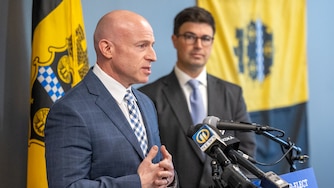
But Mr. Corbett's transportation secretary, Barry Schoch, reiterated on Wednesday that other issues, including school vouchers and fees on Marcellus Shale drilling, are higher priorities for the governor.
Several lawmakers from both parties have said that Mr. Corbett's leadership is essential to passage of any transportation funding measure. But since the governor's Transportation Funding Advisory Commission presented recommendations for raising $2.7 billion in new annual revenue in August, Mr. Corbett has said only that he is studying the issue.
The state expects spending on roads and bridges this year to decrease by $500 million, or 25 percent, at a time when more than 8,000 miles of state roads are classified in "poor" condition and more than 5,000 bridges are considered structurally deficient.
Another consequence of inaction will come in September, when the Port Authority says it will cut 35 percent of its bus and rail service if nothing is done to fill a projected $64 million deficit.
State Reps. Dan Frankel of Squirrel Hill, Mike Hanna of Clinton County and Mike Sturla of Lancaster County said at a news conference Wednesday that bipartisan support exists for a solution to the state's transportation funding problem, and that the Legislature should tackle it before taking on more politically charged issues.
"We're trying to signal our willingness to cooperate to solve a decades-old problem in Pennsylvania," said Mr. Hanna, who will introduce legislation to adopt the proposals by Mr. Corbett's commission.
Among its major recommendations, the commission called for lifting a cap on the Oil Company Franchise Tax, which is paid by fuel distributors. Currently, the tax applies to only a maximum of $1.25 per gallon of the wholesale price. Without the cap in place, the current per-gallon tax would be 13.8 cents higher for gasoline and 18.7 cents higher for diesel.
The plan phases out the cap over five years. Some or all of the increase could be passed along to drivers at the pump.
The annual fee for vehicle registration hasn't been raised since 1997. Adjusting it for inflation that has occurred since then would take it from the current $36 per year to $49. A similar adjustment in the cost of renewing a driver's license would move it from the current $29.50 for four years to $34.50.
In addition to the inflation adjustment, the commission proposed a $10 registration fee increase, with the money it generates -- $110 million -- going to local projects.
The panel also proposed several cost-saving measures. Owners would register their cars every two years instead of annually, and those tiny license plate stickers would be eliminated to save money and allow for online renewals. Driver's license renewals would be every eight years rather than every four, and private companies would be authorized to administer tests to new drivers.
Stretching out the time between registration and driver's license renewals would increase convenience for drivers while saving the state $5.5 million on reduced paperwork, the commission estimated.
Mr. Hanna's legislation is similar to that proposed in October by a key Republican, Sen. Jake Corman of Centre County, chair of the Appropriations Committee.
Mr. Corman at the time cited estimates that the proposals would cost a typical driver 70 cents a week in the first year and about $2.50 a week by the fifth year of implementation. He said not doing anything would cost more, in gasoline wasted while stuck in traffic, extra miles traveled because of detours and closed bridges, and vehicle damage from driving on bad roads.
"We're not saving our constituents money by not doing this," he said then. "The only reason not to do it is political fear, and that's unacceptable."
The Democrats offered similar rhetoric Wednesday. Mr. Hanna said inaction jeopardizes public safety, and Mr. Frankel said further decay of infrastructure and public transit would hurt the state's economy. He said leaders of Pittsburgh's business community, including the chamber of commerce and Allegheny Conference on Community Development, consider a transportation funding solution a priority.
"The business community understands that these investments need to be made," Mr. Frankel said.
In an interview with the Post-Gazette, Mr. Schoch said the governor does not want to do anything to threaten what is already a fragile economy. Raising $2 billion in new transportation funding "would take $2 billion out of the economy," he said.
Mr. Corbett is unlikely to support raising registration or license fees. He may support uncapping the oil franchise tax, coupled with a reduction in the gasoline tax paid by motorists at the pump or folding that tax into the oil franchise levy.
The oil franchise tax is assessed in mills and, if uncapped, would produce more revenue as wholesale gasoline prices rise. The existing gasoline tax, which hasn't been raised since 1997, stays at 32.3 cents per gallon regardless of the price of gas. As such, it loses value each year because of inflation and improvements in fuel economy.
Mr. Schoch said the state also will consider a fee based on miles traveled, something that several other states are weighing as a replacement for per-gallon gasoline taxes. Advocates say it is a fairer way to bill motorists for their use of roads and highways, including drivers whose vehicles run on something other than gasoline.
The state expects to spend about $1.5 billion on road and bridge projects this year, down from $2 billion last year, he said. Bond funding under a three-year Accelerated Bridge Program established by former Gov. Ed Rendell has been used up, as has money provided under the federal stimulus program.
The state is not counting on increased aid from the federal government, he said. Congress is more than two years late in enacting a new long-term transportation funding authorization law, and the issue has been snagged in partisan politics.
"I'll be happy if we're kept whole," Mr. Schoch said. "The federal government has not solved anything of substance in a long time. They've punted this for two years."
Members of Congress say they recognize the need to increase spending on transportation infrastructure but "they don't seem to want to touch any kind of revenue increase," he said.
Comments
Welcome to Post-Gazette subscriber-only commenting community. Please review our community guidelines.