
Retired Allegheny County Judge Livingstone Johnson saw much in his 95 years, from combat in war, to the sting of discrimination, to the joys of his many professional and personal accomplishments — and was made a better man for it.
“He touched many, many people. It’s a huge loss,” said lawyer Kim Brown. “That mold is broken for sure.”
“Judge Livy” as he was known to friends, was so widely admired as a county Common Pleas Court judge for 34 years that the late state Superior Court Judge Eugene B. Strassburger III referred to him as “the conscience of the court.”
Judge Johnson, of McCandless, also a notable civil rights activist and former assistant county solicitor, died Feb. 24 after a series of health problems.
He came from a long line of overachievers.
The son of Oliver Livingstone Johnson, the county’s first Black assistant district attorney, and the elder brother of the late Justin Johnson, the second African-American to serve on the state Superior Court, much was expected of Judge Johnson growing up in Wilkinsburg.
He didn’t disappoint.
Though he excelled academically, it was his time as a Boy Scout that left a deep imprint on his young spirit. When he was 12, Judge Johnson joined a local troop, where he would eventually become an Eagle Scout.
“One of the most important things you have to understand about my dad is that he was incredibly, deeply loyal,” recalled his daughter Lee Carol Johnson Cook, of Oak Hill, Va. “Some of the boys in his class invited him to join their Boy Scout troop and they happened to be white, as was their leader Bert.”
One of their badge requirements was learning to swim, but when the troop went to a local pool for lessons, Judge Johnson — the only Black child — was turned away.
“They refused to let my dad get into the pool, so Bert told the other kids, ‘Get out of the pool,’ and they did, no questions asked,” Ms. Cook said. “So, Bert took them to North Park and taught them to swim in a lake.”
Bert’s actions that day made an impression on all of the boys — but especially on Judge Johnson.
“Bert was only 22 years old, but he stood up and my dad never forgot that. To me, that’s the epitome of why my dad did the things he did. He was someone who was determined to always do the right thing,” his daughter said. “He supported LGBT rights, women and other ethnic groups, and all of that went back to Bert and what he did at the pool.”
Later in life, Judge Johnson was honored with a distinguished service award and the creation of the Livingstone M. Johnson Legacy Endowment Award by the Laurel Highlands Council of Boy Scouts.
“He was really overwhelmed,” his daughter said.
Wilkinsburg native
In 1945, he graduated from Wilkinsburg High School as the only Black student in his class. He would later be among the first inducted into Wilkinsburg High School Wall of Fame in 2010.
In a Post-Gazette story marking the occasion, Judge Johnson recalled what one of his high school teachers said about Black history.
"He said that Black people ought to be grateful for slavery, since they were fed and supported all that time," he said in the 2010 story. "When I told my mother what he'd said, she said he was wrong, that I couldn't listen to things like that."
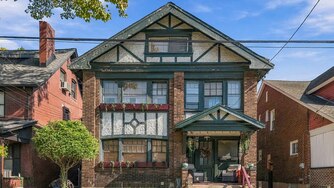
But by that time, the family was accustomed to rampant racism, especially after what his parents went through purchasing a home on Ross Avenue in Wilkinsburg in the 1920s.
“My parents had to use a straw purchaser — a lawyer and friend who was white — to buy our house in Wilkinsburg, which was an almost exclusively white suburb when we came along,” Judge Johnson told the Post-Gazette in 2021.
"The KKK had marches in front of the house when they found out," he said in a 2010 Post-Gazette story, adding that a group of his father's friends would stand armed guard on the ground floor so that his parents could get some sleep.
In 1949, Judge Johnson earned a bachelor’s degree from Howard University in Washington, D.C. He served in the university’s ROTC program and was called to active duty with the Air Force shortly after graduation.
As a navigator and radar bombardier, Judge Johnson flew 58 combat missions in the Korean War, earning the Distinguished Flying Cross and other medals before his honorable discharge in 1954. In 1963, he was among the charter members of the Hall of Valor at Soldiers & Sailors Memorial Hall & Museum in Oakland.
He earned a law degree from the University of Michigan in 1957 and joined his father’s law practice, then called Johnson and Johnson. When his brother Justin joined several years later, the firm was expanded to Johnson, Johnson & Johnson.
He became an assistant county solicitor in 1962 and began his civil rights activism in earnest by representing the Urban League of Greater Pittsburgh to ensure the hiring of Black staff members by the Pittsburgh Pirates.
“He was a trailblazer and we were grateful for his longtime leadership and support,” said Carlos T. Carter, president and CEO of the Urban League.
In his role as chair and chief negotiator of the United Negro Protest Committee, Judge Johnson worked for similar equal hiring rights at Duquesne Light Co.
When her father served as chairman of the Pittsburgh Friends of Council of Federated Organizations (COFO) Freedom Center, the building came under attack, his daughter recalled.
“My dad would take me to meetings at COFO when I was little. I would sit at the end of the conference table and draw pictures,” she said. “One day, someone shot the entire office up, through a plate glass window in a conference room where meetings were held. There was glass and bullets everywhere. If we had been in there, we’d all have been killed. I can remember him having to get our phone tapped because of all of the death threats.”
In 1957, Judge Johnson met Lee Brun Johnson and though it was love at first sight for him, it wasn’t for her —- at least not at that time.
“My father saw my mother at the [Omega Psi Phi fraternity picnic] and he thought, ‘Oh my goodness!’” his daughter said. “He asked her to dance, but my mother thought he was a married man because he was surrounded by his younger cousins. He was crushed.”
Eventually, he persuaded mutual friends to introduce them formally.
“She agreed to talk to him and he started courting her,” his daughter said. “His way of courting my mother was to take her to civil rights meetings.”
The couple were married at Heinz Chapel on April 30, 1960, and lived at their six-acre property in O’Hara they called “The Calmwood.” Mrs. Johnson died in 2020.
The judicial years
Judge Johnson was appointed to the bench in 1973 by Gov. Milton Shapp and served the first nine years in the juvenile section of the Family Division.
He was recognized with several honors for his work in the juvenile justice system, including the Homer S. Brown Law Association Achievement Award. Judge Johnson was the first award recipient, in 1994.
Some of the accolades were less formal, such as the time a young man working as a valet stopped family members and burst into tears, telling them about the ways Judge Johnson impacted his life.
“He said, ‘If it wasn’t for your dad, I wouldn’t be alive,’” his daughter recalled. “He told us about the advice and the path forward that our dad gave him when he was in juvenile court. He used to encourage kids to keep in touch with him, to let him know how they were doing.”
But it was Judge Johnson’s efforts to promote equal treatment of women in court that set him apart, whether they were litigants, witnesses or lawyers.
“Judge Johnson was absolutely a champion for women’s rights. He didn’t just support women’s rights, he was a real champion for women,” recalled Carol McCarthy, who, along with Judge Johnson, was among the founding members of the Women in Law division of the Allegheny County Bar Association in 1988.
A year later, a gender bias subcommittee was formed and co-chaired by Judge Johnson for many years. “He was someone who would never tolerate bad or discriminatory behavior, no matter how hard it was to confront people. In those days, judges weren’t called out for their bad behavior, but he did.”
“When I joined the Women in Law committee, I was struck by what a strong advocate he was for women and people of color. When there weren't many people stepping up to the plate like that — and he didn’t have to do that — he didn’t accept the status quo,” said attorney Mary K. Austin, who recalled a story that was part of the Judge Johnson lore.
“A male lawyer was questioning a female witness and he called her by her first name,” she said. “Judge Johnson told him to call her by her last name. He said he wasn’t sure if he could pronounce it. Judge Johnson said, ‘We’ll just sit here until you figure that out.’ He was a force and he really just insisted that people show respect in his courtroom.”
Judge Johnson also knew how to have fun, his daughter said, especially as a member of the Allegheny County Bar Association Players —- a theater troupe that held an annual show.
“The judges would just have one number and the one I remember the most was when the judges all played the role of traffic cones,” she said, laughing. “My dad spray painted his shoes orange and he kept wearing the shoes, because they were useful.”
Along with his daughter, Judge Johnson is survived by his other children, Oliver Morris Johnson II, of Reisterstown, Md., Judith Lee Johnson Campagnari, of Westerly, R.I., Livingstone James Johnson, of Atlanta, and Patricia Lee Johnson Pettiford, of New Orleans; a sister Justine Morris Johnson Gutzmer, of Atlanta; and nine grandchildren.
He was preceded in death by his siblings Aliscena Whitaker Hargrave, Oliver Morris Johnson, Irene Morris Johnson Guerrini, and Justin Morris Johnson.
A public visitation will be held at East Liberty Presbyterian Church from 9 a.m. to 11 a.m. Friday. The funeral will follow immediately. Burial will be private.
The family requests a memorial contribution to one of the following organizations: The University of Michigan Law School, Howard University Annual Fund Scholarships, or Boy Scouts of America, Laurel Highlands Council.
Janice Crompton: jcrompton@post-gazette.com.



Comments
Welcome to Post-Gazette subscriber-only commenting community. Please review our community guidelines.