
Most members of President Donald Trump's coronavirus task force agree that Americans should begin wearing face coverings in public and could issue formal guidance on the matter soon, people familiar with the matter said.
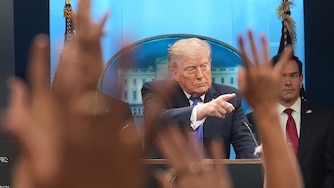
Mr. Trump signaled he was open to the idea during Tuesday's White House briefing and members of the task force are working to draft recommendations on how to fashion the coverings to prevent spread of the virus.
"My feeling is, if people want to do it, there's certainly no harm to it. I would say do it," Mr. Trump said Tuesday. "But use a scarf if you want, you know? Rather than going out and getting a mask or whatever."
His comments reflect a growing belief by administration officials that more needs to be done to prevent the spread of the virus by infected people who aren't displaying symptoms. A fabric covering of the nose and mouth could prevent the virus from reaching other people, health experts believe.
Sen. Pat Toomey, R-Pa., advised all Americans to cover their faces with scarves, bandanas or homemade masks when leaving their home for essential trips.
Yet the recommendations by Mr. Toomey — who was joined on Wednesday’s call with reporters by Sen. Michael Bennet, D-Colo. — have not yet been fully embraced by federal health officials or the Centers for Disease Control and Prevention, who have previously discouraged Americans from wearing masks unless they are sick.
Mr. Toomey began calling for people to wear face coverings on Saturday, posting a video to Twitter.
His office explained that he had decided to advocate for “Masks4All” because it was “common sense.” Mr. Toomey made clear that people should not seek to buy or hoard N95 surgical masks that health care workers desperately need.
“People watch very, very closely to what the CDC recommends,” Mr. Toomey said. “They are understandably very cautious and systematic about what they say.”
Previously, some members of the task force — including Dr. Deborah Birx — cautioned in meetings against recommending Americans wear masks because of a fear it could lull them into a false sense of protection and prevent them from socially distancing.
But new insights into asymptomatic spread of the virus have led to a reconsideration of the guidance.
"Now we've learned about this disease — and we've always said we're going to learn more, we're going to adjust — and we've learned there's a fair amount of asymptomatic spread and so we've asked the CDC to take another look at whether or not having more people wear masks will prevent transmission of the disease to other people," Surgeon General Dr. Jerome Adams said Wednesday on ABC’s "Good Morning America."
Among the issues discussed by the task force and the CDC have been how to teach Americans to wear masks and how to prevent a rush on medical-grade equipment, like N95 respirators, which are still in short supply for hospitals.
There have also been discussions of the cultural shift that recommending masks would represent, since Americans (unlike citizens of some Asian countries) are not accustomed to wearing masks in public.
And there has been some consideration of whether or not to call the recommended face coverings "masks." Some have suggested referring to them simply as "face coverings" or "courtesy masks" to distinguish them from the medical masks needed by professionals.
Dr. Anthony Fauci, the nation's top infectious disease specialist, said he would "lean toward" recommending that the general public wear face masks "if we do not have the problem of taking away masks from the health care workers who need them."
During a taping for Wednesday's "Coronavirus: Fact vs. Fiction" podcast, Dr. Fauci told CNN's Dr. Sanjay Gupta that face masks would be a "subject of conversation" at the White House.
"Particularly now that we're getting some inklings that there's transmission of infection from an asymptomatic person who is not coughing, who is not sneezing, who just appears well. Well, then how do you think that's happening?" Dr. Fauci said. "It very well could be aerosol. Maybe not aerosol, you know, that goes on for hours. But even the slight aerosol in which you're talking to somebody. If that's the case, we should at least look at the data and try to make a decision about that."
Despite a lack of conclusive evidence that masks prevent transmission of respiratory diseases, some experts have argued that nonmedical fabric masks might make a dent in transmission risk.
"Something doesn't have to be 100% effective to be beneficial," Dr. Fauci said.
Daniel Moore of the Post-Gazette Washington Bureau contributed.



Comments
Welcome to Post-Gazette subscriber-only commenting community. Please review our community guidelines.