A state House bill calling for Pennsylvania's 2,567 municipalities to be consolidated into its 67 counties is getting loud resistance from leaders and lawmakers here.
Pennsylvania House Bill 2431, proposed by a Democrat from Reading, calls for the commonwealth's counties to assume responsibility for municipal operations including law enforcement, road maintenance, land use, zoning, health and safety and sanitation. It is currently before the House Local Government Committee.
"It's a terrible piece of legislation," said McKeesport Mayor James Brewster. "Can you imagine what that would look like, having one county take care of all the roads, police, fire, everything?"
Mr. Brewster said the bill is disrespectful to taxpayers and local governments and that it hasn't been talked about enough.
"It's an insult to the people who pay the bills, mostly because it hasn't been discussed," he said. "That's not how we do business around here."
Reactions like Mr. Brewster's have been common, said the bill's author, state Rep. Thomas Caltagirone, D-Reading, who has been in the House 33 years.
The bill is co-sponsored by seven Democrats and one Republican: Peter Daley, D-California; Jaret Gibbons, D-Franklin Township; Patrick Harkins, D-Erie; Timothy Mahoney, D-Uniontown; Barbara McIlvaine Smith, D-West Chester; Joseph Preston Jr., D-Pittsburgh; Rosita C. Youngblood, D-Philadelphia; and Jim Marshall, R-Big Beaver.
Mr. Caltagirone and supporters argue that consolidating would eliminate local property tax and allow the county to draw from a broad tax base, providing services at a lower cost and buying supplies at a better rate.
"People don't get it," he said. "We have thousands of entities of local government, and they're failing.
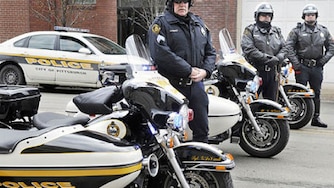
"Don't you think the county would get a better bulk rate on a fleet of police cars rather than 70-some municipalities buying their own?" he said. "Don't you think consolidating would be better than filing for bankruptcy?"
That answer is an obvious yes for Mr. Preston, who represents Aspinwall, Wilkinsburg and the city neighborhoods East Liberty, Highland Park and Homewood.
"We have hundreds of municipalities facing Act 47 in this state," he said. "How long can we go on?"
Act 47 is the state's Financially Distressed Municipalities Act, which provides for debt restructuring, limits distressed municipalities in obtaining government funding, approves participation of municipalities in federal debt adjustment actions and bankruptcy actions in certain circumstances and provides for consolidations or mergers between municipalities to relieve financial distress. Municipalities in Act 47 also receive nonresident wage tax.
Pittsburgh and Reading are distressed municipalities. Other communities in distress include Aliquippa, Braddock, Clairton, Duquesne and Rankin.
"Bigger government is not always better," said David Sanko, executive director of the state Association of Township Supervisors, which represents 1,455 townships and 10,000 local officials.
"Townships aren't failing, declaring bankruptcy or imposing widespread tax increases. Instead, it's the bigger governments - places like Pittsburgh, Philadelphia, Harrisburg and Reading - that are in real financial trouble," he said.
State Sen. Wayne Fontana, D-Brookline, said a lot of Pennsylvania's older municipalities are hurting, and the state doesn't have enough money to bail them out. He is minority chair of the state Senate Community, Economic and Recreational Development Committee and represents a large portion of Pittsburgh and its southwestern suburbs.
"We used to be able to piece something together to help a town buy a new firetruck or police car, but those days are going fast," he said. "We don't have the money to do that anymore."
But House Bill 2431 probably isn't going to be the solution, said Mr. Fontana, a former member of the Senate Local Government Committee.
It's starting a much-needed conversation, but the bill probably won't get far, he said.
To become law it would have to be approved by a majority vote in the General Assembly in two successive sessions, such as 2010-11 and then 2011-12, and then be voted on by Pennsylvanians in a referendum.
"This bill probably won't get out of committee," he said. "It's too radical."
"I don't know that you help municipalities by eliminating them," Mr. Fontana said.
He suggested struggling municipalities start by merging some of their services.
State Rep. Jesse White agrees.
Mr. White, D-Cecil, is drafting bills that he said would seek to encourage multi-municipality projects. Incentives would be offered to communities to get involved in co-ops, such as collaboratively buying street sweepers or sharing services.
His ideas, he said, allow municipalities to retain their individuality while combining for the sole purpose of attaining grant money.
A Cecil supervisor from 2003 to 2004, Mr. White said that experience has helped him recognize municipal needs.
"Having that understanding has made me a much more effective legislator," said Mr. White, whose district spans a large portion of Washington County and parts of Allegheny and Beaver counties.
"So many of our municipalities are barely hanging on," he said. "But countywide control is a step too far ... I think the key is communication and cooperation among municipal officials."
Green Tree borough manager Dave Montz said his municipality is already sharing services.
The borough shares animal control services with Castle Shannon, Dormont, Mt. Lebanon, Scott and Whitehall. It shares ambulance services with Baldwin, Castle Shannon, Dormont, Mt. Lebanon and Whitehall. And it rents a street sweeper from Dormont.
Sharing services, seeing increases in the business privilege tax, real estate transfer taxes from large commercial properties, collecting delinquent taxes and watching spending have contributed to Green Tree's fiscal health, preventing the borough from raising taxes in eight years, according to Mr. Montz.
The borough is also a member of the Char West Council of Governments, which collectively seeks bids for work and makes bulk purchases, among other functions.
"Green Tree is an example of a very well-run community doing a great job delivering services," said Rep. Matt Smith, D-Mt. Lebanon.
"There's something to be said for that local flavor and having your mayor, or councilman or councilwoman, living down the street," Mr. Smith said. "It creates an accountability and motivates them to respond to issues quickly.
"I think it makes a lot more sense to look at service mergers," he said. "I think it's too premature to talk about the county coming in."
McKeesport also shares services. The city supplies police for Dravosburg, which costs its neighbor about $120,000 annually and allows it to save on the price of health care, equipment and vehicles. Additionally, McKeesport may also be managing Dravosburg's sewage plant soon, Mr. Brewster said.
Dissolving Allegheny County's 130 municipalities into one governing body would be "a change unprecedented like any in our lifetime," said Rich Fitzgerald, Allegheny County Council president, who represents most of southeast Pittsburgh.
"It's going too far too fast," he said. "But the conversation does need to occur about what we are going to do about small municipalities that can't pay for services."
Mr. Fitzgerald said the bill probably won't become law. But if it does, he said, "Pittsburgh would still retain its individuality in its rich history of neighborhoods.
"You wouldn't lose the identity or character or sense of community. That's stronger than any political lines that can be drawn."


Comments
Welcome to Post-Gazette subscriber-only commenting community. Please review our community guidelines.