During the evening of Giving Tuesday this week, leaders of the Jewish Federation of Greater Pittsburgh’s 2015 fundraising campaign will staff a phone bank and urge supporters to pledge gifts that could be matched from a $10,000 pool donated by campaign chair David Sufrin, a retired business executive from Squirrel Hill.
The nonprofit isn’t limiting its appeal to dollars, however.
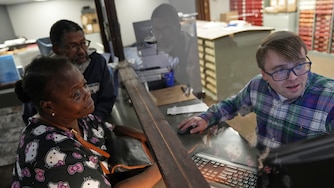
It hopes people will embrace the volunteer spirit of the third annual Giving Tuesday earlier in the day by showing up to sort food and stock shelves at the Squirrel Hill Community Food Pantry; serve lunch to seniors at the Jewish Community Center in Squirrel Hill; or help organize clothing at Thriftique, the National Council of Jewish Women’s consignment store in Swissvale.
“We thought it was the perfect marriage between fundraising and the opportunity for people to give back to the community through our volunteer center,” said Jessica Brown Smith, director of the federation’s annual campaign. With lots of buzz on social media and the Web, Giving Tuesday makes sense as a way to engage donors with the federation, she said, because, “It almost promotes itself.”
Launched in 2012 on the Tuesday after Thanksgiving as a daylong, online giving event to counter the aggressive consumerism of Black Friday and Cyber Monday, Giving Tuesday is now considered by its organizers and some participants to be the unofficial kickoff for the end-of-year holiday giving season during which charitable donations by individuals typically peak.
Last year, online donations made on Giving Tuesday jumped by 90 percent from the prior year, according to Blackbaud, a South Carolina firm that supplies software and fundraising consulting services for nonprofits. Among 3,800 nonprofits for which Blackbaud processed donations, total gifts increased to $19.2 million from $10 million on the first one in 2012.
Washington, D.C.-based Network for Good, which also coaches nonprofits and offers fundraising software and services, said the amount of donations it handled last year rose to $1.8 million from $1 million in 2012.
The average individual gift on Giving Tuesday grew by 40 percent, Blackbaud said, to $142.05 from $101.60 in 2012.
That significant boost in 2013 individual donations is likely to bode well for this year and could be evidence that overall charitable giving in 2014 will finally surpass pre-recession levels, said Eileen Heisman, chief executive of National Philanthropic Trust, a Jenkintown, Montgomery County, firm that manages $2.1 billion in donor-advised funds.
Giving from individuals, corporations and foundations totaled $335.17 billion in 2013, according to an annual report from the Giving USA Foundation and the Indiana University Lilly Family School of Philanthropy.
When the Giving USA data for 2014 is released in June, said Ms. Heisman, “I’m fairly certain we will be pretty much back to where we were before” the recession.
That would be in 2007, before the global economic crash, when giving totaled $349.5 billion.
“I haven’t seen people squirreling away money and not be willing to part with it,” said Ms. Heisman, whose firm also provides consulting on fundraising and charitable giving.
Another sign that the economy has picked up and people may be more comfortable opening their wallets, she said, was a healthy increase last year in giving to the arts and cultural organizations.
According to Giving USA, giving to those sectors totaled $16.7 billion in 2013, up 7.8 percent.
“During the recession, giving to arts was down and giving to basic human needs went up because Americans really responded to making sure people were fed, housed and their kids were getting to school with coats. Last year, the arts gained ground and that’s a sign to me that giving is shifting back to normal.”
About 40 percent of all charitable gifts in the U.S. are made in the last six to eight weeks of the calendar year, Ms. Heisman said. Whether people time those donations to coincide with the traditional holiday season that stretches from Thanksgiving to New Year’s or to make sure they rack up some deductions for their income tax returns is tough to assess, she said.
“It’s both. People are really engaged in giving and some donors don’t even know or track every penny that they give. If you put $5 or $10 in the Salvation Army bucket, most people don’t keep track of that,” Ms. Heisman said. “But I know people who save all their solicitations [from charities] for months and then take them out in December and [process] them. So it’s a little bit of the chicken-and-egg thing. It’s hard to know which comes first.”
Giving Tuesday, Ms. Heisman said, “is a smart, flexible, thoughtful way to embrace giving in whatever way that touches your heart.”
“It’s captured the American public’s enthusiasm for giving,” she said. “We’ve been so consumption-oriented that it gets people to stop and think that it’s not about how many toys or widgets you buy.”
Giving Tuesday has staying power, too, Ms. Heisman said, compared to social media fundraising sensations like this year’s ALS Ice Bucket Challenge “which are almost impossible to replicate.”
“Giving Tuesday will always be the Tuesday after Thanksgiving and you can make it about any mission you want,” she said.
The United Nations Foundation, which helped to spearhead Giving Tuesday three years ago, said this year’s event has 16,000 participating partners worldwide, including nonprofits and foundations; businesses, including eBay, Microsoft and Toys R Us; individual cities, such as Lansing, Mich., and Baltimore, Md.; and countries outside the U.S., including Ireland, Australia, Chile and Brazil.
“During the first year of Giving Tuesday, we focused on the U.S. and connected it in a way to Thanksgiving which is a fairly unique American holiday,” said Caleb Tiller, executive director, communications, for the U.N. Foundation in Washington, D.C.
“We were really surprised we got a lot of interest and inquiries coming from various countries around the world so we opened it up. No one owns it.”
Joyce Gannon: jgannon@post-gazette.com or 412-263-1580.



Comments
Welcome to Post-Gazette subscriber-only commenting community. Please review our community guidelines.