
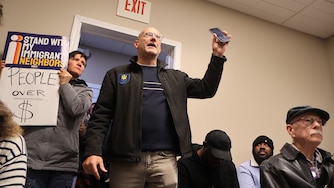
No one raised a hand when Jerome McKinney, a University of Pittsburgh professor, asked 40 people who had gathered to talk about income inequality if they qualified as members of the top 1 percent of earners.
To qualify, he noted, they would have to have an annual income of $525,000 a year. That was not the crowd represented at the Synod Hall of St. Paul’s Cathedral in Oakland on Sunday.
Instead, there were plenty of low-wage workers, local economic activists and interested churchgoers. There were also three women who have each been arrested in taking part in a national effort to have fast-food workers’ pay raised to $15 an hour.
For his part, Mr. McKinney, a professor of public policy at Pitt’s Graduate School of Public and International Affairs, pointed out that of all the developed countries, the United States was at the top for income inequality.
The starting income to qualify to be in the top 1 percent of the United States is close to 10 times the nation’s $56,336 median income and almost 35 times the annual $15,080 income of someone working full-time in a minimum wage job.
The forum on income inequality was held as part of the race and reconciliation dialogue group at St. Paul’s Cathedral. One of the speakers, James Huguley, a research associate at Pitts’ Center on Race and Social Problems in the School of Social Work, presented data on income disparity between black and white families.

Mr. Huguley said nationally white families earn $1.67 for every dollar earned by black families, but locally the disparity is higher with white workers bringing home $1.89 for every dollar paid to black workers.
He also presented the historical context of discrimination in the steel mills and in the allocation of funding through New Deal government programs and the GI Bill that helped many veterans afford a college education as well as get low-cost loans.
The fight for low-wage workers now is to see the federal minimum wage increased from $7.25 an hour. Fast-food workers are agitating for $15 an hour. President Barack Obama has called for the minimum wage to go up to $10.10 an hour.
Another speaker, Ashona Osborne, who has worked for a McDonald’s restaurant and currently works at a Wendy’s in Pittsburgh, had been arrested twice. The first time, she was protesting low wages in May at a McDonald’s shareholders meeting in Chicago.
Her second arrest came Sept. 4 when she was taking part in a nationwide strike by fast-food workers. That day, she and seven other fast-food workers linked arms and sat down on Penn Avenue in front of McDonald’s in Wilkinsburg.
The fast-food strikes, which started in New York City in 2013, are organized with help from the Service Employees International Union. The Sept. 4 strikes were held in 150 cities across the country.
“I struggle taking care of my 4-year-old son,” Ms. Osborne said. “It’s a headache deciding which bill has the higher priority than other bills.” The other bills, she said, have to wait for the next paycheck.
Her arrests, she said, have netted her the equivalent of two tickets, not jail time. The longest she was held was four hours as police processed her arrest.
She said she is not just protesting so that she earns a better wage, but also for future generations: “It’s not just for us, but my son will be able to start at a comfortable wage. We want everyone to have a living wage.”
Shyann Haten, a fast-food worker from Duquesne, said workers also have to fight wage theft. Local workers have filed multiple complaints with the National Labor Relations Board stating that employers change their hours in the company’s computer system to shave time off in order to pay them less.

Comments
Welcome to Post-Gazette subscriber-only commenting community. Please review our community guidelines.